Scorpio Rising, chapter 66
Chapter 66: Friday in San Rafael & San Francisco

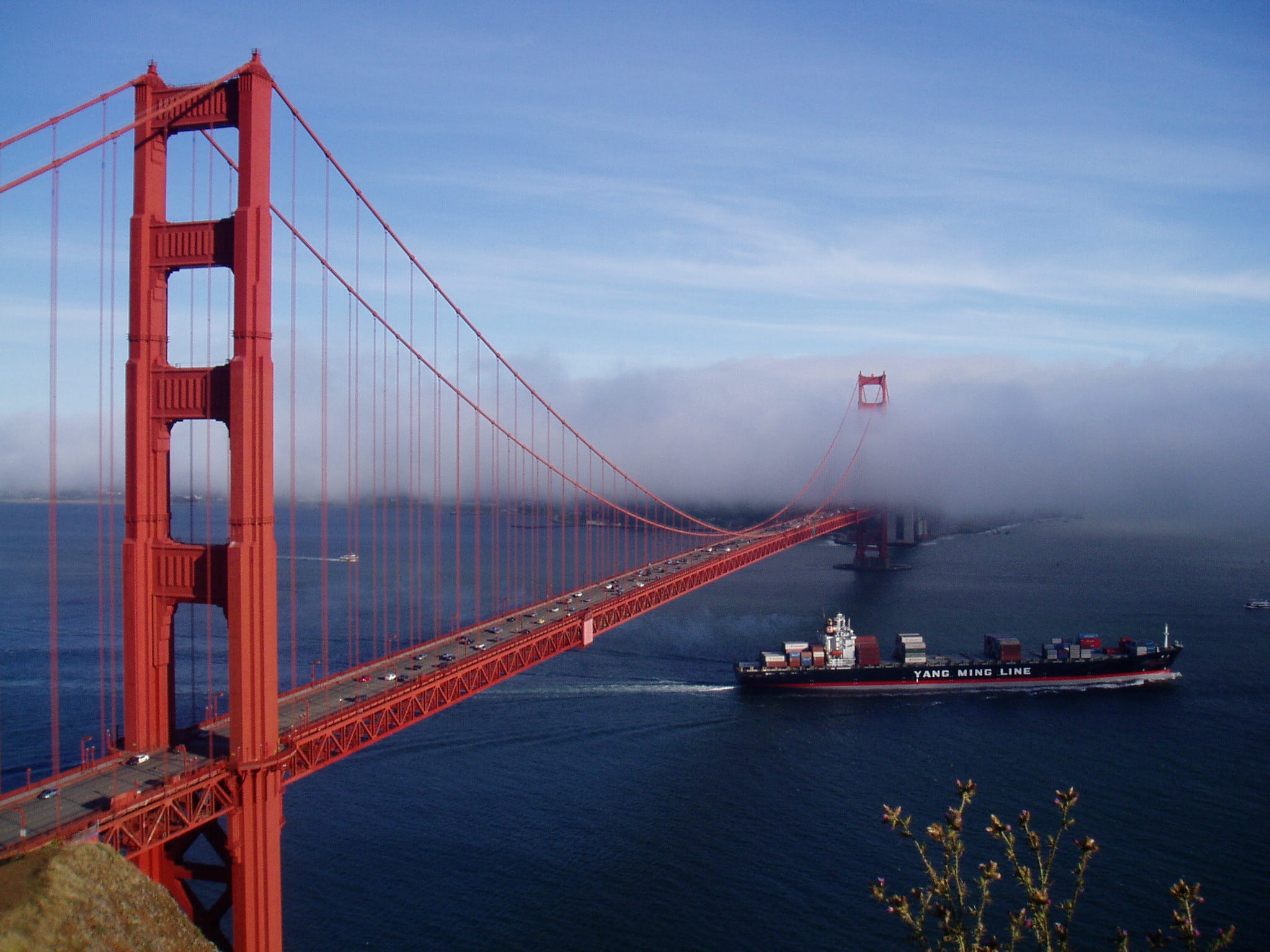
Photo credit: Cary Bass, CC BY-SA 3.0 <http://creativecommons.org/licenses/by-sa/3.0/>, via Wikimedia Commons
Chapter 66
San Rafael
Axel Crowe accompanied Starrett and Hutchins back to their office where they mobilized all available staff to work the first crucial hours of the Munson murder case. Crowe wasn’t invited to stay but he wasn’t told to go away either, so he hung around, thinking he might be able to offer some input.
The physical evidence was now at the CSU lab where knife and bowling ball were examined for latent prints. Other prints, taken from bedroom, ensuite bathroom and elsewhere in the house, were fed into the National Fingerprint File database.
Body hairs from the bed, shower drain and bedroom carpet were sorted and processed. Useless for the moment to identify a suspect, they might later be recalled if DNA comparison was required to confirm a suspect’s presence at the scene of the crime.
Starrett brought Hutchins up to speed on the bigger picture. “Bernie Lang died within an hour of two other victims, Janis Stockwell in New York and Walter Cassidy in Los Alamos. That same day, Munson was in Albuquerque, Jeb Stockwell in San Francisco, and Cassidy’s wife in New York. Crowe thinks they might have done each other a favor. We need to establish a connection.”
“I’ll start with phone records.” As part of the investigation into Lang’s death, Hutchins had already subpoenaed phone records for Bernie Lang’s mobile and land line, and Dave Munson’s mobile, and examined them for calls to known bookies, drug dealers and felons. “Can we get phone numbers for Stockwell and the Cassidy woman?”
Starrett phoned Levinson in New York to explain what they needed. Levinson had already acquired similar records for Jeb Stockwell’s home and office, his mobile and his wife’s mobile. They exchanged key telephone numbers from their respective cases and promised to report back if they got a hit.
Starrett called the Albuquerque FBI office and requested telephone numbers for Walter Cassidy and his wife. The agent on the phone refused to give out any information, and asked Starrett to leave a number so the Special-Agent-in-Charge could phone him back tomorrow.
Starrett left a number and then tried Directory Assistance for Santa Fe, where he got numbers for Cassidy’s home phone and his wife’s mobile. Dr. Cassidy’s mobile was unlisted.
Armed with these key phone numbers, Hutchins searched for a connection between Munson and Stockwell or Cassidy. Within minutes he found a call from Lang’s home to Stockwell’s home this morning.
“Munson probably thought he was in the clear until I showed up at his door asking about Stockwell,” Crowe said. “It probably freaked him out and prompted a panic call to Stockwell.”
“We should talk to New York again,” Hutchins said. “If Stockwell feared Munson might crack under pressure, his next call might have been to someone who could take care of the problem.”
Starrett called Levinson, who had by now scoured his own telephone histories and found the call from Lang’s house to Stockwell’s this morning. “Right after that incoming call,” Starrett asked, “any outgoing calls to New Mexico or California?”
“No,” Levinson said. “But if he had to make a call that left no trace he could have used Skype, preferably from an internet café.”
“Any way to trace the call over the internet?” Starrett said.
“Assuming you could trace a Skype account to him, best you’d get is proof one computer talked to another. You couldn’t prove who was there at the time. And given the small transactions at internet cafés, they’re almost always in cash.”
“Any luck at your end? Did you get a warrant issued for Carrie Cassidy?”
“Yeah, but she’s gone missing. The New Mexico State Police have got a bulletin out on her now.”
“Shit! We don’t have a clue who this new player is.”
“Wish I could help you,” Levinson said, “but it’s been a long day at my end. I’ve got to go home and catch a few hours of sleep.”
“Okay, thanks for your help. We’ll talk tomorrow.”
Starrett looked at Hutchins. They both looked at Crowe. They couldn’t seem to say it, but their expressions were asking for help.
“What about the car?” Crowe said.
“What about it? Without tag numbers, we’re nowhere.”
“Based on Munson’s chart,” Crowe said, “I don’t think he was capable of killing Cassidy. You met him, what do you think?”
“I have to agree,” Starrett said. “He doesn’t have the cojones.”
“So where’s that leave us?” Hutchins said.
“Even if Munson was in New Mexico when Dr. Cassidy was killed, he probably didn’t do it himself,” Crowe said. “What if he hired someone to do the dirty work?”
Starrett nudged Hutchins. “The sixty grand.”
“What sixty grand?” Crowe said.
“Bernie Lang withdrew sixty thousand dollars a few months ago,” Hutchins said. “We were never able to figure out where it went.”
“Munson could have borrowed it from Lang and used it to pay for the hit on Dr. Cassidy,” Starrett said.
“And you said he didn’t have balls,” Hutchins said.
“If he paid someone to do a job in New Mexico,” Crowe said, “it was probably someone from the area.”
“So…?”
“If Munson came unglued the killer would be put at risk. If arrested, Munson might roll over on him in a plea bargain. So the killer came here to shut him up. You see where I’m going with this?”
“Out of town killer,” Starrett said. “Flies in, rents a car at the airport, does the job and flies home.”
“That white Sunfire Lang’s neighbor saw,” Hutchins said. “Sunfire’s a popular rental model.”
“Let’s check it out,” Starrett said. “I’ll call the airlines and get passenger lists of every flight from New Mexico in the last twenty-four. Fred, you call the airport rentals and get them to pull the files on every white Sunfire rented out in the same period.”
With nothing else to contribute, Crowe went outside for a walk. It was a beautiful spring evening and he smelled honeysuckle on the air. He walked down to 4th Street where a number of people milled on the sidewalk outside a movie theatre. Among them was a Japanese man with two children. Crowe was reminded of the Berkeley karate instructor Ken Ataka. He’d meant to call him earlier, but it had slipped his mind.
Crowe got Ataka’s number from Directory Assistance. Despite working in Berkeley, Ataka lived in San Francisco. He agreed to meet Crowe early tomorrow morning in a park near Chinatown.
Crowe bought six large coffees and a dozen cookies at a coffee shop to take back to the detectives’ office. Starrett rewarded his gesture with some news.
After 90 million print comparisons via the NFF database, the fingerprint technician had nothing to show for the effort. Other than Munson’s, there were no matches to the fingerprints gathered from the Lang house. This meant that, even if they’d captured the prints of the killer, he’d never been arrested and wasn’t in the system.
“So now what?”
“Data from the airlines and car rentals should start coming in the next hour or so.”
“Anything I can help with?”
“It’s going to be a long night for us.” Starrett glanced at his watch. “You might as well go back to your hotel. I’ll give you a ring in the morning, let you know if we’ve found anything.”
~~~
San Francisco
Crowe headed back to San Francisco on the 101 where a steady stream of traffic – wine aficionados returning from Napa Valley, weekend hikers returning from camping trips – accompanied him across the Golden Gate Bridge.
Crowe thought about Carrie Cassidy. Although Starrett had pulled her date of birth from the DMV file, Crowe hadn’t had time to look at her chart. He wondered what her next move might be. She’d come and gone from New York with stealth and swiftness, leaving little in her tracks. Would she sit waiting for the police to appear at her door? He reminded himself to look at her chart back in the hotel, although he’d have to guess her rising sign, having never laid eyes on her, knowing nothing other than she was a writer.
Back at the hotel he returned his car to the rental agency. On a whim he asked the clerk if he had any maps of New Mexico. The clerk obliged with a map of the entire Southwest.
“I’m looking for someone. Can you give me a number too?”
“A phone number?” the clerk said.
“No, just any number between one and twelve.”
The clerk shrugged. Weirdo, you could hear him thinking. He said, “Six.”
In his room, Crowe calculated Cassidy’s birth chart, using Santa Fe as a tentative birth place. He chose a Virgo ascendant because it was the sixth sign in the zodiac, the number the rental clerk had given him.
The chart made immediate sense. Mars was in its own sign Scorpio in the third house, associated with powerful desire, athleticism and the arts. Venus was exalted in the seventh house and, since it ruled the second house of vocabulary and ninth house of publishing, gave evidence of a writing career. Moon in the fifth house of authorship nailed it.
But the rest of it? Ascendant lord Mercury was in the eighth house of trauma with a debilitated Saturn, hinting at a twisted mind. Moon in Capricorn was also influenced by Saturn, more evidence of a dark mind. Although exalted, Venus combust in the seventh house with Rahu indicated marital problems, a bias for multiple relationships ranging from eccentric geniuses to renegades. Was she capable of violence? The malefic planets all exerted influences on her ascendant, its lord Mercury, the Sun and Moon.
Knowing the variables of karma, Crowe hesitated to call it deterministic but it was almost as if the woman had no choice in the matter. He recalled an infamous quote from Hitler: “I go the way Providence dictates for me, with all the assurance of a sleepwalker.”
Where would Cassidy go? Crowe checked the transits against her chart. Her ruling planet Mercury had just entered Taurus in the ninth house. The ninth ruled long-distance travel but Taurus was a fixed sign and Mercury was under the influence of Saturn, which was always a drag. He figured she would run but wouldn’t get far.
He unfolded the map of the Southwest to have a closer look at New Mexico. Thus far his investigation into Janis Stockwell’s murder had centered on three areas: New York, San Francisco and Santa Fe. But he might just as well substitute Albuquerque for Santa Fe since that’s where Munson was when all three deaths occurred.
Crowe drew three lines connecting Albuquerque, Santa Fe and Los Alamos. In his mind’s eye he compared it to a larger triangle connecting New York, San Francisco and Santa Fe. Both were roughly the same triangle he’d seen in the cracked pavement where the NYPD had outlined Janis Stockwell’s outflung hand.
Crowe studied the area around Los Alamos where Dr. Cassidy had died in a car fire, possibly caused by a bomb. The map’s topographic features caught his eye. In the mountains west of Los Alamos was the crater of an ancient volcano, a caldera ten miles wide. Crowe thought of the hole in Dave Munson’s face caused by the bowling ball. He reflected on Dr. Locard’s exchange principle – every killer left a little piece of himself at the crime scene and took a little piece away. Although Locard had referred to material evidence, in Crowe’s worldview that was only the grossest element on a broader spectrum of manifestation.
A gory image floated into his mind’s eye: Munson’s face with the bowling ball driven into his forehead. Blood from his right eye socket had run down his cheek. Crowe superimposed this image onto the map of the Jemez Mountains. From the volcanic caldera, a rift descended from its southwest quadrant and ran down a valley through a place called Jemez Springs.
It wasn’t much to go on but it was a piece of the puzzle. Even if it didn’t make sense, that could change overnight. Starrett and Hutchins were now running down leads, assembling information. This was like a jigsaw puzzle. Sometimes you had a piece in your hands but you didn’t know what to do with it until you recognized the pattern in the surrounding pieces and then everything fell into place.