Kala Sarpa case study (9c): Abraham Lincoln
Kala Sarpa with Rahu in the 9th house, Ketu in the 3rd

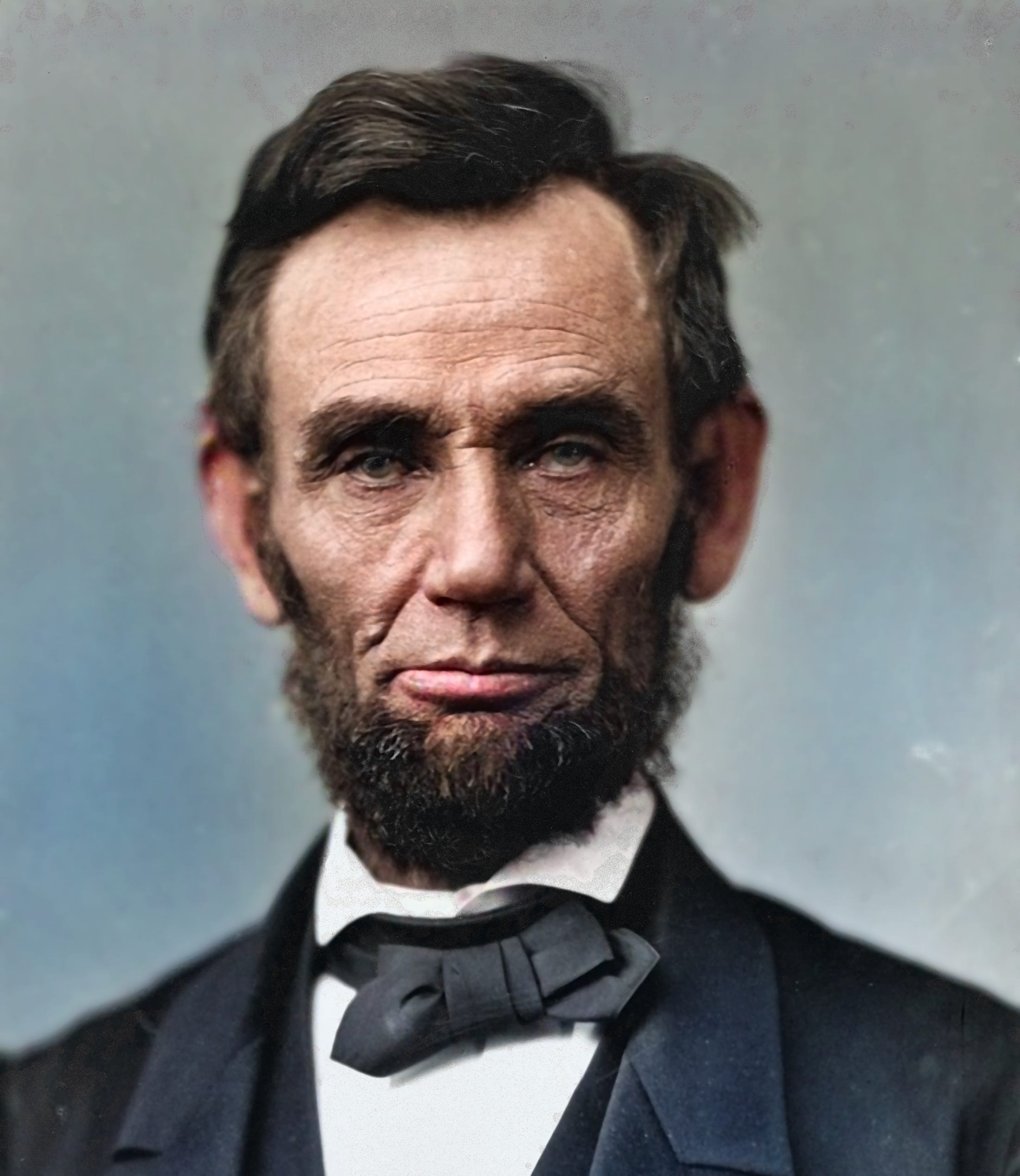
Picture credit: IceKoldKube, CC BY-SA 4.0 <https://creativecommons.org/licenses/by-sa/4.0>, via Wikimedia Commons
Abraham Lincoln
Abraham Lincoln (12 February 1809 - 15 April 1865) was the 16th President of the United States, serving from March 1861 until his assassination in April 1865. Lincoln led the United States through its Civil War – its bloodiest conflict and arguably its greatest moral, constitutional, and political crisis. Thus, he preserved the Union, paved the way to abolish slavery, strengthened the federal government, and modernized the economy.
Lincoln grew up in rural Kentucky, a tall (6’4”) and gangly youth of great wit and verbal facility who delighted in telling jokes and engaging in debates. He lost his mother at age nine, and his sister at age 19, after which he succumbed to a spell of depression that plagued him on and off throughout his life. A self-taught lawyer, he was admitted to the bar at age 27 and became a capable attorney, meanwhile reading Shakespeare and studying geometry in his spare time to discipline his mind.
After a stint in the Illinois legislature and later in Congress, he was nominated by the new Republican Party to be its Presidential candidate and won the national election in 1860. Opposing his calls for the abolition of slavery, almost immediately seven Southern Confederate states declared secession, and launched the Civil War, which ultimately claimed over 800,000 lives.
Despite the war, Lincoln enacted major legislation during his term: the Revenue Act to establish an income tax, the Abolition Act to end slavery, the Homestead Act to settle the West, the Pacific Railway Act to build a transcontinental railway, and the National Bank Act to strengthen the national currency. Having wielded a significant role in the civil war, appointing generals and participating in strategy, Lincoln lived to see Confederate forces capitulate. Less than a week later, he was assassinated on 14 April 1865.
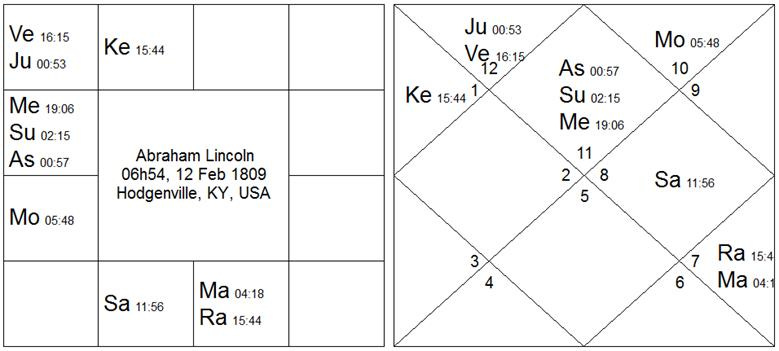
In Lincoln’s chart, Mars occupies the same sign as Rahu, but lies outside the nodal axis, so this is a Class 4 “Potential” Kala Sarpa. It’s a viloma type, with the rest of his planets moving toward Ketu, which becomes an initial point of analysis. With Mars on the nodal axis, this creates dosha unrelieved by any benefic influence on the nodes. Since Mars is also Ketu’s dispositor, this merely ups the ante.
Lincoln was born into Sun dasha, Mercury bhukti. Sun is ordinary but Mercury has dig bala in the 1st house, and participates in multiple yogas: Budhaditya and Raja yoga with the Sun, Saraswati yoga with Jupiter and Venus, and arguably, a Shubhakartari yoga rendered weak by the Moon’s relative darkness.
Rahu is swa nakshatra, which gives this Kala Sarpa additional power. Rahu’s dispositor is Venus, exalted in the 2nd with its lord Jupiter, creating Sushubha yoga. Since Jupiter rules both the 2nd and 11th, this also creates two powerful Dhana yogas with 9th lord Venus. Although Lincoln was never wealthy, these two strong benefics in the 2nd speak to his political capital and, most famously, his eloquence. Given the role of Venus (Rahu’s sign lord) in these various yogas – Dhana, Saraswati, Sushubha – this generates significant positive outcomes associated with the Kala Sarpa.
Ketu is considered swa rashi in the moolatrikona sign of Mars whose nature it shares. It gets an additional boost via its dispositor’s aspect upon it, even though Mars itself is ordinary by sign. But Ketu’s nakshatra dispositor is exalted Venus, so this too helps the Kala Sarpa elevate Lincoln’s status.
Although subtle, Lincoln’s two ascendant lords are both strong and well-placed. His shtoola lagna lord Saturn is swa nakshatra in the 10th house, while his sookshma lagna lord Mars is swa nakshatra in the 9th. The latter in particular is especially powerful for someone whose life was guided by dharma – the principle of following a moral course – while together they imply a great capacity for government via their occupation of the 9th and 10th houses.
In terms of exaggerated planets, Lincoln has only two – the dark Moon and his exalted Venus.
All of the major events in Lincoln’s life occurred in periods of planets that are swa nakshatra – Mars, Rahu, Jupiter and Saturn. Such is the power of Kala Sarpa’s amplification, that almost any excuse will allow it to leverage whatever strength is available, and take it to its logical limits.
Moon dasha covered age two to 12. In Moon-Ketu, when Lincoln was nine, his mother died.
Mars dasha, age 12-19, was unremarkable.
Rahu dasha ran from age 19 to 37. In Rahu-Rahu, age 19, his sister died. In Rahu-Saturn, age 25, he was elected to the Illinois legislature. In Rahu-Mercury, age 27, he was admitted to the bar. In Rahu-Sun, age 33, he was married.
Jupiter dasha ran from age 37 to 53. In Jupiter-Jupiter, age 37, he was elected to Congress. In Jupiter-Rahu, age 51, he was elected 16th President of the United States. The following year he introduced the Revenue Act to raise monies for public works.
Saturn dasha, age 53 to his death, saw Lincoln take on the biggest challenges of his life – the abolition of slavery and the secessionist Civil War caused by the southern Confederate States’ opposition to abolition. Entirely within the span of his Saturn-Saturn bhukti, 1862-65, he introduced multiple bills of sweeping legislation – the Abolition Act of 1862 to end slavery, the Homestead Act of 1862 to facilitate settlement of the West, the Pacific Railway Acts of 1862 and 1864 to create a trans-continental railway, the National Bank Acts of 1863 and 1864 to regulate banking, and the institution of Thanksgiving as a national holiday in 1863.
Throughout this same period, he had to cope with a struggling war economy, political fallout from devastating death tolls on battlefronts in the South and, as Commander-in-Chief, managing a rotating cadre of military generals until he found a winner in Ulysses S. Grant, also a Kala Sarpa native. By great coincidence, his famous Gettysburg Address was delivered during this same bhukti, on November 9th, 1863, when the transiting planets were in a Kala Sarpa configuration!
In one of history’s greatest ironies, the ink was barely dry on the surrender document signed by Robert E. Lee of the Confederate States when, just five days later, in Saturn-Mercury, Lincoln was assassinated on April 14, 1865.
The reference book Kala Sarpa is available in digital and print format at Amazon.